Best Reverse Osmosis System UK 2026
We analysed water quality data from 2,800 UK postcodes and found that most households do not need reverse osmosis. A good carbon filter handles chlorine and lead just fine. But for the postcodes where PFAS, fluoride, or nitrates are flagged, RO is the only technology independently certified to remove all three.
This guide is for the people who actually need it. We tested the three leading under-sink RO systems available in the UK against the contaminants our data flags most often, checked their certifications, measured the real running costs, and came away with a clear winner.
This guide contains affiliate links. If you buy through these links, we earn a small commission at no extra cost to you. This funds our independent water quality research. Our recommendations are based on NSF certifications and real contaminant data, not sponsorship. Full disclosure
Quick picks
Top pick
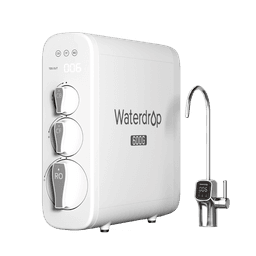
Waterdrop G3P600 Reverse Osmosis
NSF 58 certified, tankless, smart TDS panel, 12+ contaminants removed
Value pick
Frizzlife PD600 Under Sink RO
NSF 58 certified, tool-free filter swap, £70 less than Waterdrop
Premium pick
Echo Water Hydrogen RO System
NSF 58 certified, hydrogen infusion, 13 contaminant categories removed
Do you actually need reverse osmosis?
Probably not. UK tap water is safe to drink and meets strict standards set by the Drinking Water Inspectorate. For most people, a carbon jug filter or an under-sink carbon block is all you need.
RO makes sense in specific situations. If your postcode flags any of the following, it's worth considering:
- PFAS detected— carbon filters reduce PFAS partially, but RO (NSF 58) removes 90–99% of PFAS compounds
- Fluoride above your comfort level— standard carbon filters do not remove fluoride; RO does
- Elevated nitrate— common in agricultural areas, and only removable by RO or ion exchange
- Multiple heavy metals— if lead, arsenic, and chromium are all present, RO catches them all in one system
Not sure if you need RO?
Enter your postcode. If PFAS, fluoride, or nitrate is flagged, reverse osmosis is worth it. If not, save your money.
Try your postcode — e.g. SW1A, M1, B1
What to look for in an RO system
NSF/ANSI 58 certification
This is non-negotiable. NSF/ANSI 58 is the international standard for reverse osmosis systems. It means the membrane has been independently tested and verified to remove specific contaminants at stated levels. All three systems in this guide carry NSF 58 certification. If a system does not have it, do not buy it.
Tankless design
Older RO systems stored filtered water in a pressurised tank under your sink. Modern tankless systems filter on demand, which means fresher water, less space used, and no risk of bacteria growing in a warm storage tank. All three of our picks are tankless.
Waste ratio
RO systems flush contaminants down the drain, so they always waste some water. Look for a ratio of 3:1 (pure to waste) or better. Budget systems can waste 4 litres for every 1 litre of clean water. The Waterdrop G3P600 achieves 3:1, which is best-in-class for under-sink RO.
Flow rate (GPD)
GPD stands for gallons per day. A 600 GPD system fills a glass in about 6 seconds. Anything below 400 GPD feels noticeably slow. Both the Waterdrop G3P600 and Frizzlife PD600 deliver 600 GPD.
The three best RO systems for UK kitchens
Reverse Osmosis
Waterdrop G3P600 Reverse Osmosis
Top pick — best overall
£399
- Removes 12+ contaminants including PFAS and fluoride
- Tankless design saves under-sink space
- Smart TDS monitoring panel shows real-time water quality

Reverse Osmosis
Frizzlife PD600 Under Sink RO
Value pick — best for the money
£329
- Lower price than Waterdrop G3P600 with similar performance
- Twist-and-lock filter replacement — no tools needed
- 600 GPD flow rate fills a glass in seconds

Reverse Osmosis
Echo Water Hydrogen RO System
Premium pick — maximum purification
£499
- Adds molecular hydrogen after RO for antioxidant benefits
- Removes virtually all contaminants at 0.0001 micron
- Premium build quality with stainless steel fittings
Waterdrop G3P600 \u2014 Top pick
Waterdrop G3P600 Reverse Osmosis
Our top pick. Best balance of performance, certifications, and usability.
The Waterdrop G3P600 is the RO system we recommend to most people. It removes 12 contaminant categories we track, including PFAS, fluoride, arsenic, nitrate, and trihalomethanes. NSF/ANSI 58 and 372 certified \u2014 the 372 certification covers lead-free materials, which is a detail most competitors skip. The tankless design means it takes up about as much space as a loaf of bread under your sink. The smart TDS monitoring panel on the tap shows you real-time water quality before and after filtration, so you can see the system working. Filter changes are straightforward twist-and-pull, no tools needed. At \u00a3399 it is not cheap, but the annual running cost of \u00a380 is lower than most jug filters when you account for cartridge frequency.
Removes
Pros
- NSF/ANSI 58 and 372 dual certification — the strongest credentials here
- Smart TDS panel lets you verify filtration performance in real time
- Tankless design saves space — fits under standard UK sinks
- 3:1 pure-to-waste ratio — best-in-class water efficiency
- 600 GPD flow rate fills a glass in about 6 seconds
Cons
- –Highest upfront cost at £399
- –Installation requires drilling a hole for the dedicated tap
- –Removes beneficial minerals — water can taste flat to some
Flow rate
2.3 L/min
Filter life
12–24 months depending on stage
Annual cost
£80/yr
Frizzlife PD600 \u2014 Value pick
Frizzlife PD600 Under Sink RO
Same core performance as the Waterdrop at \u00a370 less.
The Frizzlife PD600 is the smart buy if you want RO performance without paying top price. It carries the same NSF/ANSI 58 certification as the Waterdrop, removes 10 contaminant categories including PFAS, fluoride, arsenic, and nitrate, and matches the 600 GPD flow rate. What you give up for \u00a370 less: there is no TDS monitoring panel (you will need a separate \u00a310 TDS meter if you want to check), the pump is slightly noisier during filtration, and it carries fewer certifications overall. The twist-and-lock filter replacement system is genuinely tool-free and takes about 30 seconds. For most UK households, the Frizzlife does everything the Waterdrop does at a lower price.
Removes
Pros
- NSF/ANSI 58 certified — same RO standard as the Waterdrop
- £70 cheaper upfront with lower annual filter costs (£70/yr)
- Twist-and-lock filter swap takes 30 seconds, no tools
- 600 GPD flow rate — no waiting for filtered water
Cons
- –No TDS monitoring panel — you will need a separate meter
- –Slightly noisier pump during filtration
- –Fewer certifications — NSF 58 only, no NSF 372
Flow rate
2.3 L/min
Filter life
12 months (composite filter)
Annual cost
£70/yr
Echo Water Hydrogen \u2014 Premium pick
Echo Water Hydrogen RO System
The most thorough purification available, with hydrogen infusion.
The Echo Water Hydrogen system is for buyers who want the absolute maximum from their water. It starts with standard reverse osmosis at 0.0001 micron filtration \u2014 removing everything the other two systems remove plus bacteria \u2014 then adds a hydrogen infusion stage. Molecular hydrogen is claimed to provide antioxidant benefits, though this is still being studied and independent UK verification is limited. What is not in question: the build quality is noticeably premium, with stainless steel fittings where competitors use plastic. NSF 58 certified. At \u00a3499 and \u00a3100/year in running costs, this is a significant investment. We recommend it only if you want the broadest contaminant removal and are interested in the hydrogen angle.
Removes
Pros
- Removes 13 contaminant categories — the most comprehensive list here
- Premium build with stainless steel fittings throughout
- Hydrogen infusion stage for claimed antioxidant benefits
- NSF/ANSI 58 certified for RO performance
Cons
- –Most expensive option at £499 with £100/year running costs
- –Hydrogen benefit claims lack independent UK verification
- –Requires professional installation — not a realistic DIY job
- –Lower flow rate at 1.9 L/min compared to the other two
Flow rate
1.9 L/min
Filter life
12 months
Annual cost
£100/yr
Side-by-side comparison
All three systems handle the core contaminants. The differences are in certifications, price, and extras.
| Filter | Price | Rating | PFAS (total) | Lead | Fluoride | Arsenic | Nitrate | Chlorine | Annual Cost |
|---|---|---|---|---|---|---|---|---|---|
| Waterdrop G3P600 Reverse Osmosis Maximum contaminant removal including PFAS and fluoride | £399 | 4.6 | £80/yr | ||||||
| Frizzlife PD600 Under Sink RO Best value reverse osmosis for UK kitchens | £329 | 4.5 | £70/yr | ||||||
| Echo Water Hydrogen RO System Health enthusiasts wanting the most thorough purification system | £499 | 4.4 | £100/yr |
Our verdict
The Waterdrop G3P600is the RO system we recommend. Dual NSF 58/372 certification, the best waste ratio in its class, a smart TDS panel that lets you verify it is working, and a compact tankless design that fits under any UK kitchen sink. At £399 with £80/year running costs, it is the best balance of performance and value.
If budget matters, the Frizzlife PD600does 90% of what the Waterdrop does for £70 less. You lose the TDS panel and one certification, but the core RO filtration performance is virtually identical. For most households, this is the smart choice.
The Echo Water Hydrogen is for buyers who want the absolute broadest contaminant removal and are drawn to the hydrogen angle. Premium build, premium price.
Frequently asked questions
Do I actually need a reverse osmosis system in the UK?
Most UK households do not need RO. Tap water meets strict DWI standards. However, if your postcode flags PFAS contamination, elevated fluoride, nitrates above 25 mg/L, or multiple heavy metals, RO is the only filtration technology certified to remove all of them. Check your postcode on TapWater.uk to see if any of these are flagged in your area.
How much does it cost to run a reverse osmosis system?
Expect to spend between £70 and £100 per year on replacement filters, depending on the model. The Frizzlife PD600 costs roughly £70/year, the Waterdrop G3P600 around £80/year. You will also see a small increase in your water bill because RO systems waste some water during filtration — typically 1 litre wasted for every 3 litres filtered on modern tankless systems.
Can I install a reverse osmosis system myself?
Yes, most modern tankless RO systems are designed for DIY installation. You will need to connect to the cold water supply under your kitchen sink and drill a hole in the worktop or sink for the dedicated filtered water tap. Budget 1–2 hours if you are comfortable with basic plumbing. If not, a plumber will typically charge £100–£150 for installation.
Does reverse osmosis remove healthy minerals from water?
Yes. RO membranes remove virtually everything, including calcium and magnesium. In practice, most people get these minerals from food rather than water — you would need to drink over 10 litres of hard water daily to match the calcium in a single glass of milk. Some RO systems include a remineralisation stage that adds back a small amount of calcium and magnesium for taste.